|
The brain is a soft organ which floats in fluid inside the skull. In an accident the brain can be damaged by bruising, tearing, shearing, shaking or twisting. Bleeding can occur in or around the brain.
The brain is divided into sections called lobes. The lobes carry out different functions around the body. Typically in a Traumatic Brain Injury (TBI) the frontal and temporal lobes are damaged. These lobes control functions which include learning, emotions, memory, and language. Every brain injury is very different, however, and no area of the brain is invulnerable.
What are the different types of Traumatic Brain Injury?
There are two main two main types of TBI: Closed Head Injury and Open Head Injury.
Closed Head Injury:
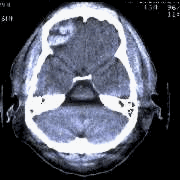
Frontal Epidural Haematoma
A closed head injury may result when the head has hit another object but the skull has not been broken or penetrated. A closed head injury, however, does not always result from the head hitting another object. Given that the brain is floating in fluid, in cases where there is sudden acceleration or deceleration, the brain may be damaged when it is moved violently back and forth against the skull. For instance, in a car accident, the head does not necessarily need to hit a part of the car. In a closed head injury damage is typically generalised and may be severe. Loss of consciousness may occur.
Open Head Injury:
An open head injury is where an object penetrates or fractures the skull. The injury may be focal or diffuse. Loss of consciousness may occur.
What are the Common Causes of Traumatic Brain Injury?
The most common causes of TBI are motor vehicle accidents, falls, workplace and sporting injuries, as well as assaults. It is estimated that between 7800 and 10000 people in NSW every year sustain a TBI. 70% of these people will be between 16 and 24 years of age.
What can happen after a Traumatic Brain Injury?
A TBI can lead to problems with mobility, vision, hearing and cognition. Cognition may include functions of memory, planning, language and problem solving.
Rehabilitation aims to help people recover from disabilities and handicaps caused by their injury, and, where possible, compensate for the abilities that they have lost.
What are Other Types of Brain Injury?
The brain may be in a number of ways which are different to a TBI. These are frequently referred to as Acquired Brain Injuries (ABI). ABI’s include hypoxic brain injury (caused by prolonged lack of oxygen to the brain) and conditions that cause bleeding in the brain such as stroke or cerebral aneurism. These are usually treated in a different rehabilitation setting.
Last modified: Thursday, 20 April 2006