
SOUTH WESTERN SYDNEY AREA
HEALTH SERVICE
LIVERPOOL HOSPITAL
CANCER THERAPY CENTRE
Radiotherapy
This page describes Radiation Therapy. You will be able to find information on the following:
Introduction | Simulation | CT Scan | Mould Room | Planning | Treatment | Brachytherapy | Side Effects | Skin Care | Other Facilities
| Introduction |
Radiotherapy is the treatment of cancer and some other diseases using radiation. The most common forms of radiation used at the CTC are x-rays and electrons. When cancer cells receive enough radiation they are destroyed while the normal cells have the ability to recover. A course of radiation can vary from a single treatment to six or seven weeks. The radiation oncologist will prescribe what is best for each individual case. Radiation Therapy is prescribed by a doctor called a Radiation Oncologist.
The treatment is planned by radiation therapists in conjunction with the Radiation Oncologist. Sometimes Physicists assist with the planning. The radiation treatment is delivered by radiation therapists whom you will see every day during treatment. If you have any questions, please ask you radiation therapist. There are radiation oncology nurses who will help with dressings and other medical needs.
What is Radiation Therapy?
Radiation therapy is mostly used for the treatment of cancer. High energy x-rays are used to kill the tumour cells. Only the area specified by the doctor is treated, unlike chemotherapy which goes through the whole body. Treatment is given by a Radiation Therapist.The x-ray machine, called a linear accelerator, directs the x-rays to the site of the cancer. You can not see or feel anything when the treatment is being delivered. Everyone has treatment designed specifically for them therefore you can not compare your treatment with someone else.
How long is the treatment?
You will have treatment once a day from Monday to Friday. You will not have treatment on weekends, public holidays and machine service day which is once a month. A notice will be put up about "no treatment day". Your doctor will advise you about how long your course of treatment will last, normally it is 2 - 6 weeks long. Sometimes you will have 2 treatments in 1 day but the radiation therapist will notify you of this.
Each treatment lasts only a few minutes. From the time you are taken into the room and given all your treatment it will be 10-15minutes. Most of the days you will be treated on time, but there may be days when it might be delayed. So allow at least ˝ to 1 1/2 hours each day.Before you get any radiation therapy treatment, the doctor needs to plan how to give it to you. There is a 2 stage procedure before you start your treatment: Simulation and Planning
| Simulation |
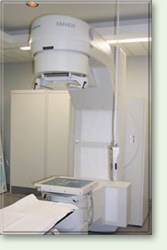 It is necessary to individualise everybody's treatment and this is done during simulation. Simulation may take up to one hour and is the longest part of the treatment process. Simulation is where the radiation oncologist together with the radiation therapists 'map' out the area that requires treatment.
1. The position you will lie on the bed will be explained to you by a radiation therapist, since everybody's treatment is different.
2. The therapist will feel for certain bones on you and mark them with texta.
3. The radiation therapists work in pairs and work with the lights dimmed most of the time. They use laser lights to make sure you are straight. These laser lights are not dangerous.
4. Once the doctor decides/marks the area to be treated, you will be left in the room by yourself for a few minutes at the most.
5. The radiation therapists and the doctor go outside the room to look at you on the x-ray screen. The doctor then decides exactly what area is to be treated.
6. The radiation therapists will move the bed remotely from outside to position you accurately. They may also move the machine from outside.
7. During the whole procedure it is important that you lie very still and are relaxed. You can breathe normally.
8. The radiation therapists will be watching you, if you have any problems, wave your hand.
Radiation therapists will draw marks on you 1 or 2 x-rays will be taken. The machine will be moved around to another angle from which you may be treated Radiation therapists will take measurements. Depending on what area is being treated, you may be given a permanent little pin prick called a tattoo. The tattoo will be used to set you up in exactly the same position everyday for your treatment.
| CT Scan |
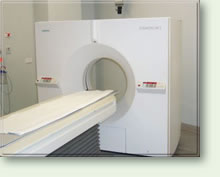 After the simulation most patients will have a CT scan on the same day. A CT scan of the region to be treated will be taken.For some treatment sites, CT is done before simulation. The doctor decides this.
Once CT scan is completed, the radiation therapist may tell you when you will start treatment or will have to ring you later.These CT scans will be used to plan your treatment.
| Mould Room |
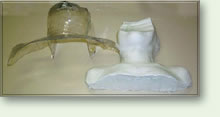 If you are receiving treatment to your head and neck region, you will need to come for a mould room appointment before your simulator or CT appointments.
1. A cast of your face & neck or face & head will be made
2. During treatment you will be wearing this cast. The aim is to keep you very still during the entire treatment.
3. A few layers of wet plaster bandages will be placed around the area to be treated and a shape of that area will be taken.
4. The radiation therapist uses the impression to make a cast.
5. Sometimes the doctors may request a mouth bung which is moulded to your individual shape to help keep your tongue in a particular position.
6. You will be required to come for another MR appointment on the day of simulation to fit your cast.
| Planning |
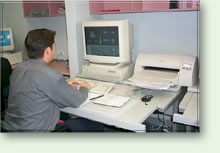 The time between simulation and when you start your course of treatment is used to plan your treatment. Planning uses the data collected in the simulator and from the CT scan. and is transferred to the planning computer where many calculations are performed (shown on the right). This ensures the cancer cells get the prescribed radiation dose whilst the dose to normal tissue is kept to a minimum.
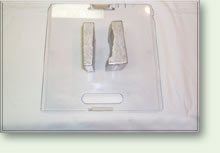 The radiation therapist uses the information from the simulation and the CT scan to work out exactly where the x-rays should be directed, called treatment fields, and also calculates the amount of radiation dose given from each field.They use computers to plan the treatment.If necessary they will make special shields (similar to those shown on the left) to protect delicate parts of your body and only treat the exact area.
| Treatment |
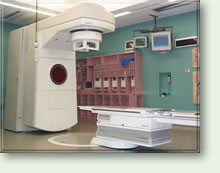 Treatment is given using a linear accelerator (similar to the one shown on the right) to produce high energy x-ray radiation. The patient will not feel or see anything during the treatment but will hear the machine making a buzzing noise. The treatment is very similar to having an x-ray taken.
For each treatment the patient should only be in the treatment room between 10-30 minutes. The patient will be positioned in the same way as they were in the simulator and asked to remain very still. The radiation therapists then line up the treatment machine with the marks and measurements recorded on the simulator.
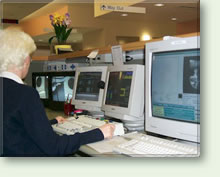 The radiation therapists will leave the room to turn the machine on but during this time they are watching the patient on a TV screen (as shown in the picture on the left). The machine is switched on for between 1-5 minutes each day, however, the entire treatment process may require the radiation therapists to come in and out of the room several times while the patient remains very still.
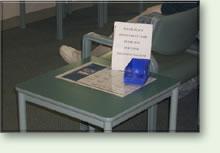 You come everyday and leave your appointment card in the blue box and wait in the waiting room.
1. On the first day of treatment, you will be given a gown to keep until the end of your treatment when you will return it.
2. When it is your turn for treatment, a radiation therapist will ask you to change into the gown.
3. On some days , your treatment will be slightly longer compared to other days, because we will take x-rays. These x-rays are used to verify what is being treated is the same as the x-rays taken during simulation and also it is a permanent record of the area being treated.
4. They will position you carefully on the table using the tattoos and laser lights.
5. The radiation therapists will mark on your skin: tattoos, and certain bones. Again they work with the lights dimmed. This is the reason they mark on your skin, so that they can see them in the dark.
6. The treatment machine, is similar to the simulator.
Again you feel nothing from the machine. You will only hear a buzzing noise when the machine is turned on.
1. The radiation therapists will move the machine to the direction from which you will receive the x-rays.
2. Any special shields and devices will be placed onto the machine.
3. If a cast was made you will be wearing it throughout the treatment.
4. The radiation therapists will leave you in the room and go outside to turn on the machine.
5. They will be watching you from outside on a video monitor.
6. It is very important that you are relaxed and lying still during the treatment.
7. After one field is treated (approx. 1min), the radiation therapists will come back and move the machine around you to the direction of the next treatment field or they may move the machine from outside. This depends on the number of treatment fields.
8. For some treatment fields the machine may come close to you but it does not touch you.
9. Your doctor will see you regularly during the treatment to see how you are going with the treatments and if you are having any problems.
10. If you have any problems or questions during treatments, do not hesitate to talk to the staff on the machines.
| Brachytherapy |
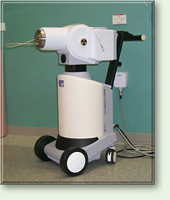 Brachytherapy is another form of Radiation Therapy. It can be given in conjunction with External beam Radiotherapy or alone.
Brachytherapy involves delivering the treatment using a small radioactive source which enters the body. This is performed via an applicator placed in body cavities or through needles placed in the tissue. Sometimes a mould placed on the skin is used.
You will not be radioactive after the treatment
| Side Effects |
Some people do not experience any side effects. Others may experience a few side effects. It depends on what sort of radiation therapy treatment you have, where you have it and what dose of radiation has been prescribed.The common side effects that occur are:
Tiredness (coming everyday)
Red, tanned or itchy skin
The side effects only relate to the area being treated eg. if the head is treated, hair may fall out, or if your stomach is treated, you may have nausea.You can see the machine staff and/or tell the doctor , as there are treatments for all side effects.A variety of side effects may be experienced depending on the area of the body being treated and usually occur 1-2 weeks after the commencement of treatment. The radiation oncologist will explain possible side effects with each patient.
General side effects include tiredness and red itchy skin. Tiredness occurs because it is part of the body's natural healing process and because of the stresses placed on the patient as they have to attend the radiation therapy department daily. The skin within the treatment area may become red and itchy, like sunburn, but this reaction can be lessened by avoiding soaps, creams, deodorants, and talcum powder. It is only necessary to avoid putting these products in the treatment area once treatment has begun. These can be resumed once treatment is completed. Most patients complete treatment without major problems.
| Skin Care |
There are some simple things you can do to look after your skin. Do not apply any:
Cream
Deodorants
Lotion
Ointment
Make-up
Perfumes
Soap
We have a resource centre where you can look at books, videos and listen to audio tapes and use Internet. There are pamphlets available on various topics.Also we have CD and Cassette players in each of the treatment rooms. If you would like to listen to one of your favourite songs/music, you can get the CDs or tapes and the staff can play it for you while you are receiving the treatment.
| Other Facilities |
There are other facilities available at this centre:
Dietitian
Wig Library
Social worker
Cancer Group Programs
Clinical psychologist
Look Good, Feel Better
Occupational therapist
Physiotherapist
Speech therapist
Resource Centre
We have a resource centre where you can look at books, videos and listen to audio tapes and use Internet. There are pamphlets available on various topics.
Also we have CD and Cassette players in each of the treatment rooms. If you would like to listen to one of your favourite songs/music, you can get the CDs or tapes and the staff can play it for you while you are receiving the treatment
© Copyright 2002 - Cancer Therapy Centre, Liverpool Hospital, SWSAHS
Disclaimer
Last modified: Tuesday, 8 July 2003