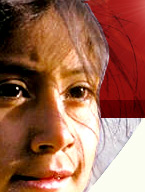
BEAUTIFUL PEOPLE
d. Jasmin Dizdar (1999)
Now
available on video
“You’re
English. Never forget that”. So one English football hooligan
tells another in Beautiful People, a movie about the day-to-day
travails of an assortment of Bosnian refugees in London but which
has a few corrosively pertinent things to say about nationalism
of any stripe. While English football hooligans play at refighting
old battles in the pubs and in the stands, entire nationalities
do the same thing for real in vicious wars. It’s the same myopic
hatred, just on an immensely larger scale.
The
Balkans have provided tragically fertile soil for filmmakers in
recent years. Beautiful People, a British film by a Bosnian director,
is partly a black comedy but also a poignantly knowing portrait
of refugees in a country whose attitude to them is deeply ambivalent.
They are a dislocated underclass, housed in council flats if at
all, let adrift in a strange place, hampered by language barriers
in gaining access to services such as health, patronised by the
complacent upper class, kept at arm’s length by mealy-mouthed
politicians and regarded by established immigrant communities as
a threat to already dwindling resources. To the racist white unemployed,
they are to be scorned, blamed and resented. Problems at home, problems
abroad.
Several
stories are skillfully tracked. Refugees encounter an indifferent
Britain; Londoners encounter a distant and unwanted war. Idealism
collides with pragmatism. An idealistic young medico falls in love
with a handsome refugee at her NHS clinic, to the distaste of her
snobbish Establishment family; when she takes him home, one of them
says cluelessly “personally, I’m very much against ethnic
cleansing” while another holds up the historical fact that
the English Civil War was 400 years ago as some kind of lesson.
A young husband and his wife, raped by Serbs in the war, seek an
abortion from a weary English doctor on the edge, himself battling
an ex-wife for custody of his own kids. A middle-aged Croat and
Serb get into a name-calling brawl on a London bus and pursue their
rather farcical vendetta even into the hospital ward they end up
sharing with a curmudgeonly Welshman; and a paralytically hungover
English soccer hooligan named Griffin wakes up in wartorn Bosnia
without a clue how he came to be there.
Beautiful
People’s humanism brings an appealing warmth. When Griffin
is awoken by starving Bosnian peasants poking at him, it’s
boisterous black humour; but when he stumbles uncomprehendingly
through a UN field hospital, farce is mixed with tragedy. He volunteers
his stash of heroin to anaesthetise a bloody amputation, his first
ever act of true selflessness. It’s a moving sequence upon
which the movie and indeed the whole of Griffin’s life hinges
-- when he returns home Griffin is no longer a mindlessly xenophobic
football hooligan. The Bosnian husband and wife are slowly persuaded
by the weary English doctor’s benign humanity that they cannot
visit the prejudices of the past on an unborn, blameless child.
The grumpy, hostile Welshman in the hospital ward - product of a
culture repressed for centuries by the English - makes the Serb
and the Croat put aside their animosities, or at least compel them
to understand that they aren’t the only peoples with a bone
to pick.
Their
stories are realistic and humanely told, and engagingly small-scale
even if the issues are not. If I have one criticism of Beautiful
People, it’s that the resolution of the various stories is
a little too schematic, a little too neat, and the story of the
BBC war correspondent grappling with post-traumatic stress syndrome
is not quite convincing. On the whole, Beautiful People blends black
humour and humanist concern to bring empathy and a sense of hope.
The concluding scenes - video footage of a happy wedding day in
Bosnia before savage animosities overwhelmed it - are a bitter-sweet
echo of the weary English doctor’s advice to the young pregnant
Bosnian bride: “If life works out just a tiny little bit in
your favour, it can be beautiful”. Words of a sadder and wiser
man.
Reviewed
by David Bolton
|