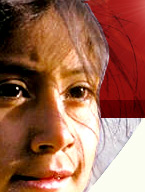
CHILDREN AT WAR
By Olga Yoldi
The
modern Western idea of childhood is a relatively recent creation.
It is generally perceived as a period of innocence and visionary
imagination, however this romantic idea of childhood does
not apply to the overwhelming majority of children. Few children
in third world and developing countries are actually safe
to grow to the fullness of life.
For
countless numbers of these children there is no peace in their
lives, only terror. Caught in violent conflict, they are enduring
almost unimaginable suffering. Children are losing life, wholeness,
home, family, opportunity and hope. Their innocence and openness,
which calls us to cherish and protect them leave children
especially vulnerable. Learnt hatred, fears and enmities are
planting (in children) the seeds of future conflict.
In
an unspeakable perversion of innocence, more and more children
are being drawn as soldiers into violence, they are too young
to resist the consequences of which they cannot imagine. Every
year thousands of children are recruited around the world.
Their experiences are brutalising. They are exposed to severe
hardship, harrowing experiences, serious injury and sometimes
death.
In
November last year Swedish Save the Children held a
press conference to launch a new report called "Children:
The Invisible Soldiers". The report is based on extensive
research in 26 countries and shows that the use of child soldiers
is far more widespread than generally realised.
Among
the report found that an estimated 250 000 children under
18, some as young as 7, are presently serving around the world
in government armed forces or armed opposition groups.
Children
took part actively in 33 armed conflicts in 1995-96; most
child soldiers join armed opposition groups and paramilitary
groups. Moreover several governments’ armed forces have
sent children under 18 into combat; child soldiers often carry
out extremely dangerous tasks such as mine detecting and spying.
The
report actually documents numerous cases of how children are
exploited and abused, such as the story of this Burmese boy:
"Sometimes when I fell asleep when I was on sentry duty,
I was beaten by my corporal. He beat me like a dog, like I
was an animal, not a human being. There were 2 or 3 suicides
during that time, of boys who had been hospitalised and finally
shot themselves".
In
countries in West and Central Africa, children as young as
8 to 10 years of age are forcibly recruited, coerced or induced
to become combatants. Although exact figures are unavailable,
the estimated number of 20 000 to 50 000 child combatants
often cited is considered an underestimate.
Approximately
90% of all child soldiers are boys. Survival, self esteem,
revenge of death of family members, peer groups pressure and
coercion by adults and family members are some of the factors
compelling children to participate in the wars in West and
Central Africa.
The
demobilisation of child soldiers has been constrained for
a variety of reasons; including the lack of political will
on the part of military leaders, the absence of sanctions
against recruitment, weak national demobilisation structures
and the social disintegration of families and communities.
The
report makes recommendations on how to reduce the volume of
child recruitment. For example, international and national
legislation on recruitment, improved documentation of children,
including the routine provision of birth certificates and
monitoring of recruitment practices by relief agencies operating
in conflict areas. However, it would be rather difficult to
monitor and enforce these measures on governments generally
because the mechanisms are not in place to do so.
The
United Nations General Assembly in 1993 unanimously called
on the Secretary General to appoint an expert to conduct a
study on the impact of armed conflict on children. Fifteen
representatives from a wide variety of African countries participated
in the regional consultations and formulated a number of recommendations.
They highlighted the fact that the prevention of war requires
addressing and eliminating the root causes of conflict, until
this happens children will always be at risk.
The
recommendations addressed issues such as the reduction of
arms, more accountability on the part of governments, using
mechanisms for conflict prevention and education. They also
declared the targeting of children and their recruitment as
soldiers of war as crimes, and crimes against humanity.
So
far the recommendations have remained just a written document.
Unfortunately
very little has been achieved to protect children in war.
The violations on their childhood are intolerable but failure
to respond is a betrayal and silence complicity.
The Facts
Rwanda
is called the nation of traumatised children. Children have
been exposed to atrocities to a degree never been seen before.
300.000 children were killed, often in brutal ways.
In
some of the largest mass graves up to 45 % of the victims
were children.
Over
95,000 children, 40.000 in Rwanda lost their parents or were
separated from them.
42%
lost both parents.
56%
witnessed a family member being killed.
75%
witnessed other people being killed
47%
saw children killing other children.
64%
witnessed massacres
20%
witnessed rape and sexual assault.
Many
children are able to name more than 20 persons close to them
who are dead. In August 1994 UNICEF’s child psychologists
visited the sites of massacres and talked to the children
in the area, producing the first assessments of the traumatic
effects of war on children. The Trauma Recovery Program, TRP,
within the Children in Especially Difficult Circumstances
Section was established to address the immediate and long
term psychosocial needs of war affected children and their
families.
As
part of the program UNICEF trained 12 Trauma Adviser, one
for each prefecture, in trauma alleviation methods. These
advisers passed on their knowledge to teachers, social workers,
health care providers and religious leaders. So far TRP trained
a total of 1,843 social agents in basic issues of trauma identification,
broadcasted over 1,500 Trauma First Aid messages to various
social agents throughout Rwanda. The TRP has conducted and
analysed data from a pilot survey completed in December 1994
on levels of trauma amongst children in centres and family
settings.
Amongst
the findings was the fact that 62% of those interviewed felt
they had no future and did not expect to live long. A set
of "Guidelines for Psychological Trauma Healing"
was produced by the Minister of Social Rehabilitation in collaboration
with UNICEF and seven NGOs. The Government of Rwanda acknowledged
the importance of psychosocial intervention with traumatised
children as one of its priorities.
Consequently
a national Child Recovery Centre was opened in April 1995
in Kigali to become a focal point for training, documentation
and research, with an outpatient clinic for severely traumatised
children and families.
The effects of such experiences on children, and its subsequent
documentation, was of vital importance to services providers, not
only in this country but around the globe. Hopefully it will contribute
to provide more insight on effective healing treatments and understanding
of child survivors.
|