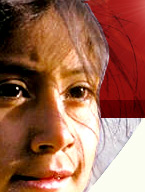
One woman’s battle for survival
by Helen Basili
A
STARTTS client speaks out
When
Zenia Collazos* entered the doors of STARTTS seven years ago,
she was in desperate circumstances. Unable to speak English,
estranged from her family, and alone in a foreign land, the
unimaginable horrors inflicted upon her by Peru’s Shining
Path guerillas haunted her with unremitting ferocity.
"I
couldn’t trust other people. When I was working, I was
looking behind me always. I never had peace. I was thinking
that people around me were going to come and attack me. I
couldn’t sleep. I couldn’t eat. Nothing. It was
horrible. Really horrible.
"I
intended to kill myself. The person I was living with was
so afraid she introduced me to a social worker," says
Zenia.
The
social worker recognised Zenia’s distress as symptoms
experienced by many refugee survivors of torture and trauma
and referred her to a counsellor at STARTTS. It was there
that the source of her anguish was revealed.
In
1987, Zenia’s father was executed by the Shining Path
guerillas from the Communist Party of Peru. She was still
coping with her grief two years later when the hospital she
was working for as a nurse was attacked by the guerillas.
"I
don’t know how many there were around the hospital. The
thing I remember was that the whole of Lima was in darkness.
[The Shining Path] bombed the electricity stations.
"When
the lights went out we tried to find some candles and suddenly
there were armed people with masks. It was so fast and unexpected.
I had to obey orders ‘Get killed or go this way’."
Zenia,
along with several of her colleagues, was kidnapped for two
weeks and forced to care for the Shining Path soldiers
who were sick or injured. After she was released, she was
too afraid to return to work and remained in the family home.
Soon
after, the Shining Path, once again in need of Zenia’s
nursing skills, located her at home and abducted her. She
was blindfolded and driven to a remote village guarded by
masked guerillas.
For
the next six months, Zenia was forced to work in silence,
forbidden to communicate with the other residents. Her escape
was a hair-raising one.
"They
had planned an attack [against the government] and they decided
to kill me after that attack because I refused to cooperate
with them. On the night of the attack, I had an opportunity
to get out. There were not many people around to control the
area."
Zenia
walked for days through the wilderness until she found a road
where she hitched a ride back to the capital. She arrived
at her uncle’s house and soon after, he organised for
her to fly to Australia on a tourist visa. The Australian
government later accepted her claim for refugee status.
In
the seven years since Zenia commenced counselling, she has
made some remarkable achievements. She now speaks fluent English,
works as a clerk and has completed the first year of an accountancy
degree at the University of Sydney.
For
Zenia, the most remarkable thing is her survival. "The
most positive thing [in my life] is that I’m alive. Thanks
to my counsellor for his professional psychological support,
I am still alive."
However,
her pain and suffering have been exacerbated by news of the
murder and rape of relatives in Peru and her continued separation
from her mother and siblings, who now live in exile in Chile.
Despite several applications made to the Department of Immigration
and Multicultural Affairs, Zenia’s family has so far
been denied permission to live in Australia.
Zenia
does not have the financial resources to bring her family
to Australia for a holiday and for the same reason she cannot
visit them in Chile. Even if she were able to go to Chile,
Zenia says she would be reluctant to do so due to Chile’s
proximity to Peru and the possibility of finding Shining Path
guerillas residing there in exile. Despite the amount of time
that has lapsed since she left Peru, her fear of the guerillas
has not abated.
Until
Zenia is reunited with her family, she says she will never
fully recover from her traumatic experiences. "Hopefully
one day God will give us a chance to be together again."
* Zenia’s real name has been changed to protect her privacy
Issues effecting treatment of torture and trauma survivors
Zenia’s
counsellor, Mariano Coello, is the Coordinator of Clinical
Services at STARTTS and has been working with refugee survivors
of torture and trauma for 15 years. He describes availability
of family and social support after a traumatic incident as
an important factor in the recovery process. Unfortunately,
these factors are often lacking for refugee survivors of torture
and trauma. In cases like Zenia’s, family support is
absent altogether due to a combination of geographical and
political factors.
Mariano
contrasts the availability of social support to survivors
of natural disasters with that of human inflicted trauma.
Survivors of natural disasters usually have a host of emergency
services directed to meet their needs whereas the survivors
of human-inflicted trauma are often neglected and left to
their own resources, says Mariano.
The
absence of physical injury and scarring is another factor
associated with a positive prognosis for survivors of torture.
"In
general, the more disabling the injury, the greater the reminder
of the trauma and the more difficult it is to cope with it.
If it is something visible then people will ask them about
it continuously," says Mariano.
A
positive outcome for survivors is more likely if they are
able to secure a financial and occupational position similar
to the one held before the torture or trauma took place. In
the case of many newly arrived refugees, who may have difficulties
mastering English and prior qualifications which are not recognised
here, this criteria is often impossible to meet, says Mariano.
The
result of the torture experience for most, but not all, survivors
will be posttraumatic stress disorder (PTSD). A diagnosis
of PTSD is based on the person’s exposure to a traumatic
event and the subsequent presence of three categories of symptoms:
intrusive recollections, avoidant/numbing symptoms and hyperarousal
symptoms.
No
theory has been able to adequately explain why some people
will develop PTSD and others won’t and the applicability
of a PTSD diagnosis to refugees from non-Western cultures
has been debated vigorously.
Mariano
believes it is more constructive to think of in terms of "post-traumatic
symptoms" because the undeniable fact is that all people
suffer as a result of their experience and whether their symptoms
are displayed in such a way that leads to a PTSD diagnosis
or not is, in many ways, irrelevant.
It
is difficult to obtain a reliable estimate of the prevalence
of torture internationally but Amnesty International reported
that people were tortured or ill-treated by security forces,
police or other state authorities in 117 countries in 1997.
A
study conducted in Europe in the early 1990’s found that
up to 35% of the world’s refugee population has had at
least one experience of torture. Another study by researchers
at Wollongong University reported in 1996 that one in four
refugee entrants to NSW had been subject to severe trauma
and torture.
Given
that 8779 refugees were admitted to Australia in 1997-98 it
may be assumed that between 2195 (25%) and 3073 (35%) of them
had experienced torture.
Not
all torture survivors are adults. STARTTS employs a youth
worker and a specialist case manager for children and other
counsellors treat child or adolescent survivors where appropriate.
"I’ve
seen kids who have seen their parents murdered or raped and
I’ve seen kids who have been tortured themselves,"
says youth worker Gary Cachia.
"Children
are sometimes in a powerless situation and if parents are
not really supportive of the treatment it becomes very difficult
to treat them.
"Sometimes
parents are so engaged in dealing with their own traumatic
experiences and the strenuous demands of resettlement that
they have difficulties identifying their children’s problems.
In other cases parents feel extremely guilty about, what they
perceive, as their failure to protect their children from
trauma.
"Paradoxically
enough, interventions with children are more successful in
shorter times than with adults in cases where there is a supportive
family and so on," says Mariano.
In
some countries, torture is viewed as a science, which is developed
and modified according to the needs of the government. Particularly
favoured are those methods that inflict unbearable pain but
leave ambiguous scars or disabilities that cannot be easily
attributed to torture. This allows the government to deny
that systematic torture has occurred.
"Sophisticated
torture methods today can destroy the personality and self-respect
of human beings, and still it will be claimed that the victims
were never exposed to torture. A new science has developed,
and torture is practiced with psychological and medical assistance
in many countries," said Dr. Inge Genefke, representing
the Copenhagen based Rehabilitation and Research Centre for
Torture Victims at a Cape Town lecture in 1995.
In
a 1997 report Arming the Torturers, Amnesty International
documented the increasing use of electric shock torture and
stun technology. "It is sometimes said that torturers
prefer using electric shock torture because they believe it
will not leave permanent marks as evidence on their victims’
bodies," the report said.
This
has ramifications for the refugee selection process in countries
like Australia where physical evidence of torture may be required
to prove that the person has been and will continue to be
persecuted in their country of origin.
However,
according to Mariano, the use of primitive torture methods
is still endemic. "I have many clients who have scars
and torture is not always so sophisticated in some countries
in some situations, that it doesn’t leave marks, cuts,
bruises, bones that have been broken and injuries.
"There
are other methods of torture that although they haven’t
left scars they have left disabilities. For example, if you
leave someone hanging by the arms for long periods or standing
for long periods or in situations that they may get infections.
I had a client who was put in a septic tank and he got huge
infections on his thighs and genitals, which had previously
been burned with cigarettes, that left him with terrible scars."
This
does not mean that he disputes the fact that torturers often
attempt to minimise the evidence of their misdeeds. "One
practice that I have heard of is that people who are detained
for short periods and are quite badly tortured, before they
are released, are treated with anti-inflammatory drugs and
anticoagulants and other medications in cases where they have
visible marks in order to discredit their account of torture,"
says Mariano.
Related
to the "science of torture" is the involvement of
medical professionals in torture. This alarming phenomenon
has been described by the British Medical Association as a
"significant ethical issue".
A
study of 200 torture survivors in the Danish Medical Bulletin
in 1990 found that 20% of them had experienced the involvement
of medical personnel in their torture.
"Ten
persons said that a doctor was present during their torture
and in some cases performed a medical examination...On the
basis of the examination, advice was given as to whether the
torture could continue.
"Fifteen
persons said that they received medical resuscitation because
they lost consciousness during the torture," the report
said.
Mariano
discusses the impact on some of his clients who identified
paramedics or medical professionals assisting their torturers:
"This [issue] came up very late in the process of counselling
therapy. They had an absolute distrust of people in helping
positions including me. They took quite a while to seek assistance
from [STARTTS] and when they started there were questions
directed to me about my political affiliations, my ideas and
the philosophies of STARTTS."
The
idea of involving medical personnel in torture might appear
strange to those who believe that the purpose of torture is
to extract information and ultimately to kill the victim,
but this is not the case according to Dr.Genefke. "The
main aim of torture is to break down, to destroy the identity,
the personality...
"[Torture
victims] are sent back to their community with all their physical
and psychological problems after torture. They suffer, they
are full of anxiety, they cannot eat properly, have nightmares,
depression, etc. Naturally, the family and the children suffer.
Others in the society are afraid of being exposed to the same
procedure and therefore do not dare to act as these courageous
persons. This is how a dictatorship creates repression and
fear in countries where there is government-sanctioned torture."
The
idea of unleashing upon society a crushed, broken individual
as a deterrent to other political activists has been largely
unsuccessful. STARTTS counsellors tell of the gratification
that they feel when they see such a person resume a fulfilling
life.
"I
can see that for many of my clients who have been extremely
traumatised, although they still remember the past, they function
in society in a very normal way and have been very successful
as well," says Lucy Marin, STARTTS counsellor for the
Spanish speaking communities.
A
Kurdish client recently dedicated a poem to STARTTS. He wrote:
" I will survive the long night and put the darkness
behind me, I will not give in to disappointment because I
am a Kurd and I was born to be strong."
|