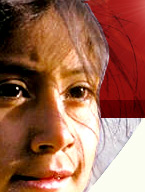
No respite for rejected asylum seeker
by Helen Basili
She has been through hell. She thought she had found a new home
in Australia but now, Rosa Esperanza is to be deported.
Rosa Esperanza is counting down the days. As the moment draws closer
for her deportation, she is filled with an increasing sense of dread.
Her airfare will be covered if she agrees to return to her homeland
of Ecuador. If not, she has to take matters into her own hands.
The choice for Rosa, is an obvious one. In Ecuador she will be
faced with a violent husband and a father-in-law who has threatened
to slit her throat. Even if she manages to avoid them there are
the ubiquitous government agents who, Rosa believes, will take her
life. If Rosa has any doubts, she only need remember what happened
last time. It is something she is unlikely to forget.
Rosa will go anywhere except Ecuador. She has three children. They
cannot afford to be left motherless. They have suffered enough.
If Rosa cannot find the strength to survive for her own sake, she
does so for her children. She will maintain her struggle so that
they may have a better future.
Speaking through an interpreter, Rosa says: "When I am with
my children I am always laughing and trying to lift their spirits.
I say ‘don’t worry about it, I know what I’m doing’."
But the reality is, their future is far from certain.
Rosa’s predicament grew out of a desire to help others. A
charity worker since she was a little girl, Rosa never dreamed that
her actions would result in such horrific consequences.
In 1996, Rosa and her family returned to Quito, the capital of
Ecuador, after a period abroad. The family were well off and this
enabled Rosa to continue her charity work. She was introduced to
some Italian nuns who invited her to join them in assisting prisoners
in the men’s and women’s jails in Quito. Rosa happily
accepted, looking forward to the chance to improve the prisoner’s
quality of life.
The work in the prisons was difficult and overwhelming at first,
but Rosa persisted. She organised religious and handicraft groups,
showed films and arranged for medical supplies and food to be distributed
among the prisoners.
Soon after commencing work in the prisons, Rosa became a member
of the Partido Roldosista Equatoriano (PRE), the ruling party in
Ecuador at the time. "They were a political party that helped
the poor. I observed them going into poor communities and building
schools and other social services. I thought it was a good party
and that was how I came to meet the sister-in-law of the president
of the republic," says Rosa.
Her involvement in the party escalated and she began to meet other
influential PRE members. Rosa was startled when she learnt that
the PRE had initiated covert, sinister activities to enrich these
members. She grew even more alarmed when she realised she was being
coerced to participate.
|
Rosa reduced her prison visits and attempted to end
her involvement with the PRE but was threatened that she
would be "taken care of" by "Los Pepudos",
the PRE's militia group.
|
According to Rosa, the president’s brother had implemented
a drug-dealing operation using prisoners in the jails where she
was active. In a statement to the Refugee Review Tribunal (RRT),
Rosa wrote: "[The prisoners] wanted to use me because I was
above suspicion. They asked me to be a courier and offered me a
lot of money. I refused. Then they started threatening me and I
became afraid. Once they put a little plastic bag in one of my books
and told the prison officer that I was carrying drugs."
Rosa reduced her prison visits and attempted to end her involvement
with the PRE but was threatened that she would be ‘taken care
of’ by ‘Los Pepudos’, the PRE’s militia group.
Terrified, she searched for other options. She discovered that the
PRE was looking for a diplomat in London but in order to get the
position, she and her husband would have to pay thousands of dollars
in bribes. As they could not afford all the money, they paid a deposit
and signed over their property deeds and belongings as security
until the balance was repaid.
Things went terribly wrong. The PRE government was overthrown on
7 February 1997 and Rosa and her family lost everything. Their hopes
of a secure life in London were shattered. Many PRE members were
fleeing the country, fearing retributions from the new government.
Rosa decided that she would have to do the same thing. Her husband
and children hid at her brother’s house and Rosa went back
to the family home to collect the few personal belongings they had
left.
There was a knock at the door. Three men bearing police identification
badges stood outside. They came in and began searching. "They
were removing books from the bookshelves. They opened all the doors
and went upstairs and checked under the beds," wrote Rosa in
her RRT statement. The men kept asking her the whereabouts of the
president’s brother and his wife. She had no idea. They bashed
her. They told her her children wouldn’t return from school.
Then they forced her into their car.
"We drove out of the city...They took me out of the car. They
took all my clothes off and the three of them raped me.
"I think after what had happened I lost consciousness. When
I awakened I was already in hospital. The doctor told me that I
was found by some people in a small town called Cayambe," wrote
Rosa.
The nightmare continued. "My brother and I told my husband
what had happened. He blamed me and accused me of having lovers
who did this to me. My husband’s family were told of what had
occurred and my brother said that my father-in-law had told him
that he wanted to kill me for all the things that my husband had
lost because of me."
Rosa had to escape. Her life depended on it. With the assistance
of a friend, she and her family were able to leave Ecuador. They
were issued with a family passport and flew to Australia on a tourist
visa in April 1997.
For Rosa and her children, life in Australia as an asylum seeker
has been an ordeal. Her husband became violent and she separated
from him last year. Soon after, she had a stroke and was hospitalised
for four months. Rosa has been caring for her children on her own
and, as an asylum seeker, she is not entitled to any social security
or medical assistance. "Sometimes I don’t understand how
up until now I have been able to survive. I think that god opens
his doors every day to give me something," says Rosa.
Recently, Rosa’s application for refugee status was rejected
by the RRT. The Tribunal accepted that Rosa had been sexually assaulted,
had experienced significant personal losses and had knowledge about
corruption within PRE. However, it considers that she does not satisfy
the criteria for refugee status under the 1951 Convention relating
to the Status of Refugees. The Tribunal believes that the harm Rosa
fears is not "owing wholly or partly to an imputed or a perceived
political opinion".
In the decision handed down by the RRT, the Tribunal member wrote:
"The fact that the applicant is targeted by those connected
with the PRE or political rivals is not because of her political
opinion but because of circumstances personal to her."
Rosa and her children are to be deported.
"I felt like a mouse in a trap [when I heard the news]. I
didn’t know what to do. I thought that [the Australian government]
were going to be able to help me especially after the situation
I have been through. I don’t really know why they haven’t
been able to help me," says Rosa.
She struggles to speak through her tears: "Sometimes I feel
like I am going through a nightmare and someone is going to shake
me and say ‘it is only a nightmare, wake up’."
Rosa and her children are leaving for Mexico. She is desperately
trying to scrape together money for the airfares. A number of fundraising
activities have been staged to help her and she will soon be prepared
for the journey. She doesn’t know anyone there but arrangements
have been made for them to stay with a group of nuns in a convent.
"I don’t think it’s good to be running with my suitcase
without any stability, running from here to there. Now I’m
going to Mexico and maybe they won’t accept me there and I’ll
have to run somewhere else," says Rosa.
Her search for respite has no end in sight.
Rosa’s real name has been changed to protect her privacy.
|