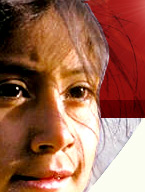
A Sanctuary after Chaos
by Helen Basili
The
meaning of childhood is obliterated for many refugee children who
have witnessed horrors beyond their comprehension. But a sanctuary
exists where they can learn to be children again. By HELEN BASILI.
A
flower-lined road leads from the gates of the property down to the
19th century sandstone pavilion on the waterfront. Extending
along the outside walls is a frieze depicting fruit-bearing cherubs
and above the main entrance stands an intricately detailed, three-story
tower. There are lush gardens of pink and white azaleas, ancient
Moretan Bay figs, palm trees and Norfolk Island pines. Inside are
Renaissance-style courtyards and fountains, stained-glass windows
and wood panelling designed by Italian and English artisans.
It
is a far cry from any refugee camp and yet this is where many refugee
children spend time in their first months or years in Australia.
Rivendell Adolescent Unit, as the place is known, is located at
Rocky Point in Sydney’s inner west. It was established as a
hospital in 1893 and became a residential treatment centre for children
and adolescents with psychiatric disorders in 1977.
However,
the Adolescent Unit only operates during school terms. During school
holidays the premises, and a few of the staff, are handed over to
three services in Sydney’s south-west who use it to run recreational
camps for newly arrived refugee children. The services are the Service
for the Treatment and Rehabilitation of Torture and Trauma Survivors
(STARTTS), Sydney Indo-Chinese Refugee Youth Support Group (SICRYS)
and the Spanish and Latin American Association for Social Assistance
(SLASA).
STARTTS
runs two camps a year from Rivendell for children aged between 10
and 13. The camps last for five days and are attended by about 30
children. Gary Cachia, a youth worker at STARTTS, believes the camps
are an important way of breaking down the isolation experienced
by many refugee young people. In doing so, they help prevent the
development of depression and other mental health problems later
on. The camps also provide an ideal environment for the identification
of any problems the child already has.
Cachia,
who has been running the camps for STARTTS since 1994, has found
children who suffer sexual and physical abuse, neglect, eating disorders,
bouts of aggressive behaviour, communication difficulties, nightmares,
flashbacks to past traumatic experiences and memory and concentration
difficulties.
Once
he has identified a problem, a plan is devised: "In most situations
we can implement a plan before the end of the week," says Cachia.
Gaining the support of the child’s parents or school can be
crucial to the success of any plan and they are often instrumental
in monitoring the child’s progress. Depending on what the child’s
problem is they may also be referred for individual counselling
or group work. Cachia has run numerous groups for Serbian, Bosnian,
Lao, East Timorese and Middle Eastern young people, according to
the level of demand at a particular time.
Rivendell’s
specialist medical staff assist in identifying problems, designing
treatment programs and finding appropriate referral services. While
they are not as intensively involved with the children as Cachia,
who has ongoing contact with them, their expertise in child and
adolescent issues is extremely valuable.
Rivendell
nurses, Gerry McShane and Paul O’Keefe, have been present at
many STARTTS’ camps. Over the years, they have acquired a considerable
knowledge of the impact of pre and post-migration experiences on
the children. They have also learnt to be aware of the particular
sensitivities of refugee youth. "When we went [with the kids]
to Bicentennial Park one time all the construction work they were
doing meant there were big mounds of dirt everywhere and some of
the kids were worried about mass graves," says McShane.
Both
McShane and O’Keefe emphasise that although the camps provide
a good opportunity to assess the children it is important to ensure
that first and foremost, the children have fun. The camps are very
much about giving the children positive experiences to counteract
the tragedies of their past.
In
this regard, the camps appear to have been a great success. Nidia
Mendoca, of East Timorese origin, attended her first Rivendell camp
in 1993, after she had been in Australia for several months. "[I
remember] the amazing activities that were offered. The staff were
funny and a bit tricky as well. I just liked the environment and
that’s why I ended up going more and more. I liked the fact
that I could meet people from different countries and actually learn
a bit about their culture as well," says Nidia.
Nidia
is now 20 years old and completing a TAFE diploma in youth work.
"I was so interested in policy making and people’s rights…I
read the course outline [for the youth work diploma] and I thought
it was something interesting and something that I would want to
do but I think it took me back to the [Rivendell] camps as well,"
says Nidia.
The
most valuable thing Nidia got from the camps, she says, is an ability
to be less serious. She also became more confident of her communication
skills: "I became more open because of my involvement in [group]
activities where we had to talk. I was really reluctant to do that
at first. I was really shy but they made me feel comfortable in
that environment," she says.
Nidia
intends to work with non-English speaking background youth when
she finishes her diploma at the end of the year. She hopes to eventually
do a degree in international community work at the University of
Western Sydney.
Shermarkee
Salah, aged 13, arrived in Australia with his mother and seven siblings
in 1996. They had spent two years in a refugee camp in Kenya after
fleeing the civil war in Somalia. A year later, Shermarkee attended
his first Rivendell camp. "The camps are fun and you get to
meet people," says Shermarkee. "The best thing was when
we had to do something on stage at the first camp I went to. Me
and my brother were singing," he says. Shermarkee and his brother
Abdi were such a success that they were asked to sing at the launch
of a youth video earlier this year.
Shermarkee
says he has made many good friends on the camps and is still in
contact with one, from the former Yugoslavia, and another, from
Iraq. Despite being hindered by a lack of English when he first
arrived, English and grammar are now his best subjects at school
and he frequently gets higher marks than other, Australian born,
students in his class.
One
of the first activities that children participate in, upon arriving
at Rivendell, is a treasure hunt. The group is split up into several
teams which work together to solve clues and compete against the
other groups to find the treasure. It is an ideal activity for breaking
the ice and getting the children to familiarise themselves with
the new environment. Apart from the recreational activities and
outings, the children engage in a number of structured group activities
where they discuss the common issues facing them and learn things
such as anger management and communication skills.
Although
Cachia has heard trenchant stories from children about their experiences,
he is sustained by what he has been able to achieve during the camps.
For example, one Bosnian girl who attended the camps had lost both
her brother and father in the war: "She wouldn’t communicate
and she wouldn’t show any emotions. It took three programs
but we got her communicating with other children and adults, smiling
and laughing. We got her to behave childishly and to misbehave and
to test boundaries which, for a child which was completely numb
to the outside world, was a huge change," says Cachia.
The
camps tend to break down any ethnic or racial barriers that may
exist between children. This is particularly so, says Cachia, with
children from Serbia, Bosnia and Croatia: "When you look at
their parents in the morning they won’t speak to each other…but
the children become good friends. After [the children attend] two
or three programs and follow-up activities, the parents come along
and the parents even start to build relationships with each other."
Camps
specifically for Indo-Chinese and Latin American youth are held
at other times in the year. These camps are organised by SICRYS
and SLASA and have similar goals to the STARTTS camps. Last year,
STARTTS and SLASA won awards from Sydney’s Transcultural Mental
Health Centre for their youth programs. This year, SICRYS has been
nominated for the same award.
Cachia
concedes that Rivendell can be a daunting place for a young child
unused to such lavish surroundings. "On first impressions for
a small child it can be a very frightening place but once that fear
is overcome, I think that has a magnificent therapeutic value in
terms that not all fear should be kept," he says. He is quick
to point out that it is not a sterile environment, that there is
evidence that other children have been there. It is, ultimately,
a place that is warm and welcoming for children. "A lot of
children ask me what does the name ‘Rivendell’ mean,"
says Cachia. "I go into a long story of Tolkien’s story
of the Hobbit and the place where fairies live. They are quite excited
by that."
|