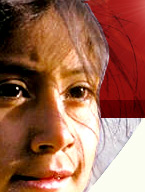
REFUGEE WOMEN: THE AUTHENTIC HEROINES
bys Nooria Mehraby
NOORIA MEHRABY reports on the plight
of refugee women and their struggle for survival.
Refugee women and their dependent
children account for 80 per cent of the world’s refugees.
But who are these women and what problems do they face? Refugee
women come from all corners of the globe. Often they come alone,
flooding the substandard refugee camps set up in neighbouring
countries. Their husbands, sons and fathers have been imprisoned,
disappeared or killed in battle leaving them to fend for themselves.
At best these women face long hours of menial employment and a
spartan roof over their head; at worst they face rape, starvation,
disease and death. For the lucky ones, respite is finally gleaned
when they are granted refugee status by Western countries. But
even then, the suffering of refugee women is far from over.
Between 1991 and 2001, 61,590 females have arrived in Australia
under the Refugee and Humanitarian program. This represents only
48 per cent of the country’s total refugee intake during
that period. Of these women, 2,419 are have been admitted under
the ‘Women at Risk’ category.
WOMEN’S EXPERIENCE OF TORTURE
AND TRAUMA
Widespread violations are perpetrated against refugee women from
the political prisoners of Iran and Latin America to civilians
in the former Yugoslavia and Afghanistan, where half the population
is kept behind the veil (Purdah).
Refugee women are arrested, abducted, imprisoned, persecuted,
tortured, raped, sexually abused and sold for prostitution. They
are often stripped naked, given electrical shocks on their vagina
and breasts, burnt on the nipples, hanged and tied from the breasts,
and forced to witness torture of other prisoners, especially torture
of close relatives. Other forms of torture inflicted on refugee
women include exposure to extremes of hot and cold temperature,
food and light deprivation, a prohibition on seeing their own
children, mock executions, bashing with electrical cables and
belts and public stoning or beating.
The UNHCR estimates that 80% of all refugee women experience rape
and sexual abuse, which are used as weapons of war. In this context,
sexual assault and rape not only affect individual survivors but
also the family and the community to which the survivor is related.
It is designed to humiliate and destroy women targeted because
of their ethnic, religious, racial, or political identity.
Eileen Pittaway discusses the purpose of rape in her article ‘Refugee
Women: The Unsung Heroes’: “Women are raped to humiliate
their husbands and fathers, and for reasons of cultural genocide.
They are forced to trade sex for food for their children. They
are raped by the military, by border guards and by the UN peacekeeping
forces sent to protect them. Rape and sexual abuse is the most
common form of systematized torture used against women, and this
ranges from gang rape by groups of soldiers, to rape by trained
dogs and the brutal mutilation of women’s genitalia.”
During the war in the former Yugoslavia, mass rapes were perpetrated
with alarming frequency: between 1992-1995 it is estimated that
around 30,000 to 50,000 women were raped. Chilean women who opposed
Pinochet’s military regime were repeatedly raped by government
officials and imprisoned until they became pregnant and gave birth.
Women are also at risk of being raped during the escape from their
country of origin. For example, hundreds of Vietnamese women were
raped by pirates as they fled their country in boats across the
seas of Thailand.
In refugee camps, single women may experience sexual harassment
both from men who live locally and from fellow refugees. In Dadaab
refugee camp in Kenya and Lukole refugee camp in Tanzania, women
searching for firewood on the camp outskirts have been subjected
to rape by local bandits. In Pakistan, Afghan widows are held
in isolated areas controlled by Afghan guerilla leaders and are
forced into arranged marriages with guerilla fighters.
Despite a high incidence of sexual assault and rape amongst refugee
women, the crime is often shrouded in silence. Due to stigma,
shame and guilt associated with loss of virginity or purity it
is difficult for women to reveal their horrific experiences. This
tendency is more pronounced in some cultures, such as Middle Eastern
cultures, where a woman’s virginity is a prized possession
and sex out of marriage is forbidden.
During the five years I worked as a doctor in Afghan refugee camps
in Pakistan, none of my female patients ever reported a sexual
assault and rape although there was much anecdotal evidence to
suggest that such events were occurring among the camp population.
Similarly, a study held in Winnipeg, Canada, found that over 94%
of refugee sexual abuse survivors did not disclose their experiences
to their refugee workers.
For some women the threat of rape is so ominous that they have
committed suicide to avoid it. For instance, several women in
the Shamali district in North Afghanistan killed themselves in
a hot tanoor (a clay oven) because they feared being raped by
Russian soldiers attacking their village. Several other women
were killed by their male relatives because they were in danger
of being raped by the invaders. They felt that having a female
relative who was raped would bring a lifetime of shame and wounded
pride. Amnesty International also documented similar cases, which
had happened during the civilian war in Afghanistan.
BEARING LOSS
Refugee women often experience the unnatural deaths of numerous
family members including children, husband, and other male supports
such as fathers and brothers. They also experience loss of identity,
homeland, property culture and social status.
In Rwanda, 90% of the householders are women, due to death or
imprisonment of their husbands. A study conducted in Afghanistan
found 84% of women reported one or more family member killed in
the war. In another study conducted in a Cambodian refugee camp
in Thailand, 80% of women had lost more than one child in the
four years prior to the survey. Research carried out in Sudan
in 1985 found that 34% of women had lost one child in the past
four months.
Because husbands and other male relatives have often been disappeared,
imprisoned or killed in battle, women find themselves fleeing
their country of origin alone or without the protection of a male
relative. This makes them more vulnerable to rape and banditry.
They often face a long journey through treacherous terrain where
guerilla activity may be present.
LIFE IN THE REFUGEE CAMPS
Life in a refugee camp is not any easier for women refugees as
they are still exposed to danger, starvation and death. Refugee
women may find themselves the primary care giver of their family,
responsible for the care of their children and the sick, disabled
and elderly members of the family. Their time is occupied with
the most basic tasks of survival: finding food, medicine and shelter.
Women are often forced into low-skilled jobs to feed their children.
Their pay is so low and conditions so tough that prostitution
becomes a more viable option for some. There are limited opportunities
for training and education for women and their children in the
refugee camps.
Although some women are waiting for a peaceful repatriation when
hostilities in their country end, many refugee women are hoping
to obtain asylum in a Western country. But even the quest to obtain
asylum becomes problematic when the refugee camp is located in
a country where corruption is endemic. In Pakistan, for instance,
it is extremely difficult for a woman to move freely in a camp
or in the residential area. This makes it hard for them to access
foreign embassies or the UNHCR office to register their refugee
status. (Cost of transport, inability to speak the local language
and lack of childcare are other barriers). Even if they are lucky
enough to reach those centres they face corrupt officials who
will only process their claim in return for bribes. For an empty-handed
refugee woman, money for bribes is impossible to procure. As a
result many women stay in refugee camps for years, cut off from
the world.
Eileen Pittaway describes women’s lives in refugee camps:
“…They wait in substandard situation divorced from their
culture and from all they have known, watching their children
grow without the education training and socialization necessary
to equip them to deal with the world. They know that they are
becoming de-skilled as the world moves on, and they do not move
with it. Self-esteem shrinks as the days pass.”
PHYSICAL HEALTH OF REFUGEE WOMEN
Both in exile and in the war torn country, refugee women’s
physical health deteriorates significantly. However, the extent
of these problems is different from camp to camp and it is related
to preexisting problems, culture, religion and level of international
support. Inadequate diet, chronic malnutrition, chronic infectious
diseases, repeated pregnancies and unhealthy and poor hygienic
environments are the cause of much ill health in refugee women.
Other factors involved in poor health include overcrowded living
conditions and a lack of access to immunization, health care facilities
and education.
Women have less access to medical facilities in refugee camps
than men as most medical practitioners in the camps are male and
in many Islamic cultures it is unacceptable for a female to see
a male doctor. Further barriers to medical care exist in many
war-torn countries. A study of women who lived in the Afghan capital,
Kabul, prior to 1996 found that 77% experienced poor access to
health care services there and an additional 20% had no access.
Eleven per cent said curfews prevented them from seeking medical
care.
Women experience a high incidence of cervical cancer and sexually
transmitted diseases due to lack of screening facilities. In Afghanistan,
infectious diseases are very high among women, for example, 70%
of all tuberculosis cases are detected in women.
Mortality and morbidity during childbirth are common, both in
refugee camps and in war-torn countries, due to a dearth of professional
assistance and proper hygienic practice at delivery. For example,
in Afghanistan trained health workers attend only 9% of all deliveries
and more than 90% of babies are delivered by relatives. The maternal
mortality rate is 1700 out of 100,000 live births which is among
the highest in the world. The overall life expectancy of Afghan
women is 42, the lowest in the world.
The death of a 20 year-old Afghan refugee women in a camp in Peshawar,
Pakistan, still disturbs my memories. She died of massive bleeding
on the way to a health clinic after she gave birth to her first
child in her tent. She was just one out of hundreds of women that
cannot even get out of their houses to seek medical assistance.
Many refugee women are fleeing countries in the Middle East, South
East Asia and Africa, which practice female genital mutilation
(FGM). The incidence of FGM varies from country to country but
ranges from about 90% in Somalia, Djibouti and Sierra Leone to
around 30% in Senegal. FGM is a traumatic procedure usually performed
without anaesthetic and in unsanitary conditions. As a result,
many women who have experienced FGM suffer lifelong health problems
such as repeated urinary tract infections, stones in the urethra
and bladder, growth of scar tissue at the site, cysts and chronic
pelvic infection resulting from obstructed menstrual flow.
THE PSYCHOLOGICAL IMPACT OF THE
REFUGEE EXPERIENCE
Refugee women can suffer from a variety of psychological problems
ranging from minor anxiety and depression to severe post traumatic
stress disorder (PTSD) and psychosis. In cases of rape and sexual
assault feelings of dirtiness, fear, flashbacks, nightmares powerlessness,
shame, guilt, loss of confidence and self-esteem, depression and
anxiety are predominant. Furthermore many rape survivors experience
various gynaecological problems such as menorrhagia (excessive
menstruation), dysmenorrhea (painful menstruation) or amenorrhea
(absence of menstruation), which stem from their feelings of psychological
distress.
Psychological problems among women refugees are often somatised,
or expressed in the form of physical problems, if it is culturally
inappropriate to express emotion. This is the case in many non-Western
cultures where psychological problems bear a lot of stigma and
sufferers may be labelled ‘mad’.
Refugee women also experience intense bereavement and grief over
the deaths of loved ones. This is exacerbated when numerous relatives
and friends have died, as is often the case in war-torn countries.
In refugee camps the psychological problems of residents are often
under-estimated or ignored due to more urgent physical health
problems and the basic tasks of survival.
SETTLING IN A NEW COUNTRY
Women who are granted refugee status in a new country arrive with
the hope of putting together the pieces of their scattered lives.
Yet they now face the daunting task of adapting to a new culture
and society that is very different to anything they have ever
known. Refugee women can find themselves overwhelmed with a multiplicity
of settlement problems such as language difficulties, financial
problems and a lack of knowledge about public transport, housing,
employment, the legal system, education and other services.
While refugee men have greater opportunities to socialize and
learn the language of their new country, refugee women are often
left isolated looking after their children and completing house
duties. They lose the traditional social support provided by the
extended family and social gatherings.
Continuation of war in their homeland, destruction of their community,
concern about scattered family members and changes in the structure
of their family are other challenges faced by refugee women. Single
mothers also carry the burden of raising their children by themselves.
They may be forced to work in low-skill jobs to support their
families.
Some refugee women become the victims of domestic violence as
their husbands, who are also deeply traumatised, are unable to
control their anger and subject their family to violent outbursts.
In many instances, this is not spoken about as women do not know
their rights and may come from cultures where women are considered
the property of their husband and thus unable to complain. Refugee
women find themselves coping not only with their own traumatic
memories, but also the ongoing trauma of their husbands’
violence.
Refugee women have special needs and require specialized assistance
that is provided by STARTTS and other torture and trauma treatment
services around Australia. In a new country, the needs of refugee
women are best identified by a comprehensive assessment of their
physical and psychological problems and settlement difficulties.
Supportive counselling in a safe and culturally appropriate environment
allows them to explore the depth of their suffering and heal their
wounds. Along with practical assistance, such as housing and employment-seeking
skills, this helps to give them the safety and financial security
they deserve.
Inspired by the strength of refugee women settling effectively
in Australia, I believe they are not a burden on the Australian
society. Although, they may look empty handed they enrich Australia
with their strength, wealth of experiences, knowledge and skills.
Refugee women are the battlers, the survivors, and the true heroines
of the war.
Nooria Mehraby is a STARTTS’
bicultural counsellor for the Middle Eastern communities.
References
1. Amnesty International (1995) Afghanistan Women in Afghanistan
Human Rights Catastrophe, London.
2. Ferguson, N (1999) The Shadow Hanging Over You: Refugee trauma
and Vietnamese Women in Australia. Nobody Wants to Talk About
It Refugees Women’s Mental Health Trascultural Mental Health
Sydney
3. Godinjak, S (1999) Sexual Assault, It is impact and how to
deal with it. An information booklet for Bosnian Community. Center
Against Sexual Assault CASAHouse. Victoria Australia
4. Pittaway, E. (1991) Refugee Women Still at Risk in Australia.
Australian Government Publishing Services, Canberra.
5. Pittaway, E. (1999) Refugee Women The Unsung Heroes. Nobody
Wants to Talk About It Refugees Women’s Mental Health Trascultural
Mental Health Sydney.
6. Rasekh, Z & M Manos (1998) ‘Women’s Health and
Rights in Afghanistan’, The Journal of the American Medical
Association, Vol.280: 449-455, August, 1998.
7. Refugee Policy Advisory Committee (1997) Strategy direction
in refugee health care. Sydney: NSW.
8. Siddiqi, S. (1997) Health Sector Report and the Health Situation
Analysis in Afghanistan for the United Nation Children Fund (UNICEF).
Peshawar, Pakistan.
9. UNHCR, Internet http://www.unchcr.ch
10. WORLDREFUGEE INFORMATION (1997) Rwandan Women Seek Solution
Internet, http://www.refugee.org/world/article/women
refugee.htm
|